How XBOW Compares
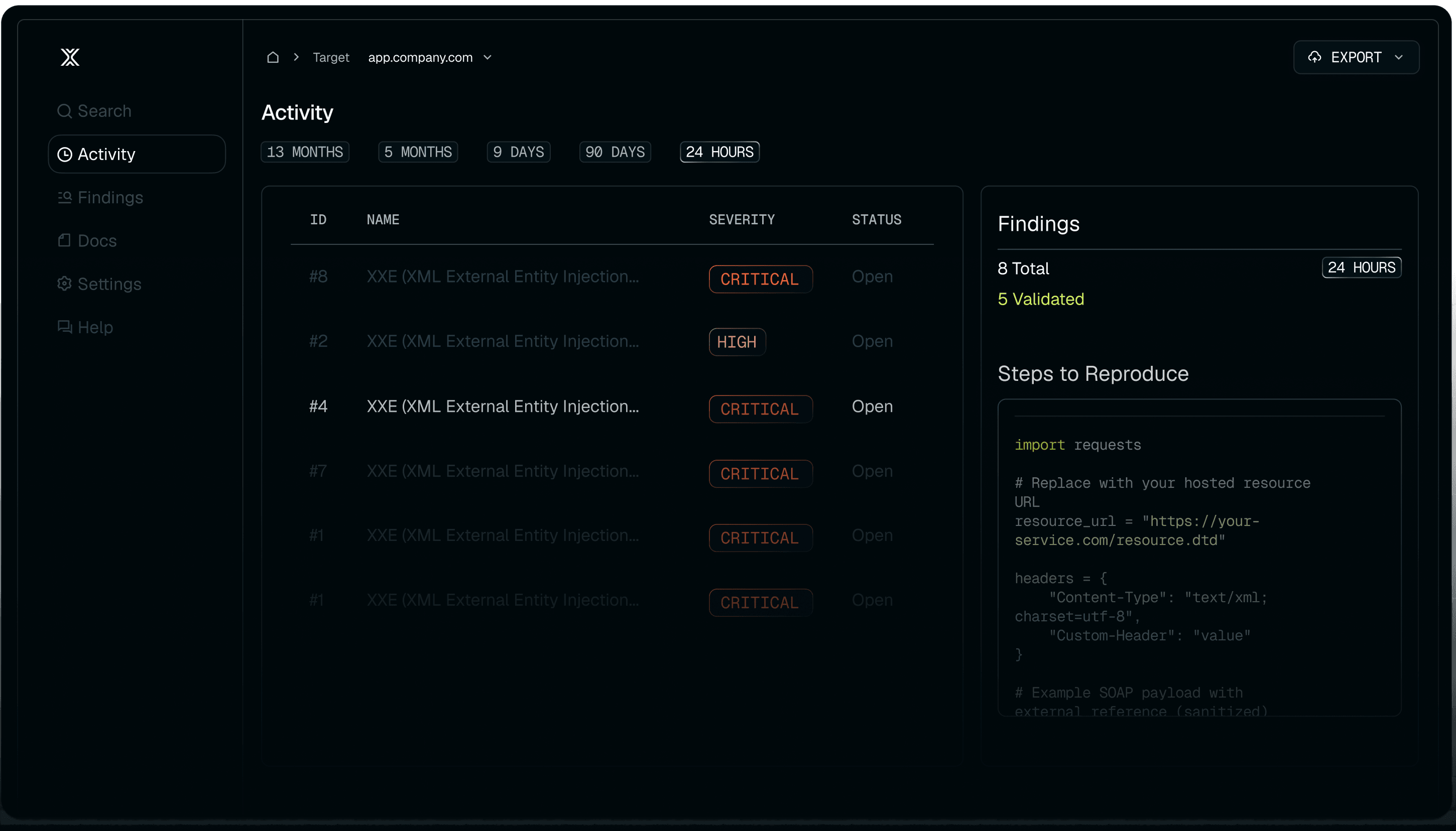
Every vendor in this category says AI. For some, that means a scanner with a model attached. For others, it means human testers with AI tools. XBOW attacks, chains, and proves exploits on its own, inside the scope you set.
Compared With Manual Penetration Testing
A good pentester brings judgment and context to a web application. You book one once or twice a year, and the report describes the application as it was the week they tested it.
| Criteria | MANUAL PENTEST | |
|---|---|---|
| Cadence | A scheduled engagement, annual or twice a year | Continuous, or on demand with every release |
| Coverage | A scoped sample, limited by tester days | Everything in the scope you set, tested in parallel |
| Evidence | A report with findings and screenshots | A replayable trace and a working exploit for every finding |
| Time to start | Weeks from scoping to the first day of testing | On demand, no scheduling |
| Retest | A new engagement | The next assessment |
| Cost model | Per engagement, per tester day | Priced to coverage |
| Controls | Rules of engagement agreed per test | Scope you set. Every action logged and reviewable |
| Where manual still wins | Infrastructure, physical and social engineering, red team objectives | Outside XBOW's scope. Hand your testers the map and proven chains so they spend their time where judgment matters |
Run both. XBOW tests every web application continuously, and your testers go deep where the trace points.
Compared With Pentest as a Service
PTaaS fixed the scheduling problem and kept the human, but it did not fix consistency. The tester on your platform this quarter is likely not the tester from last quarter, and depth changes with them.
| Criteria | PENTEST AS A SERVICE | |
|---|---|---|
| Who does the work | A marketplace or bench of human testers, with tooling | Autonomous agents, coordinated, with independent validators |
| Consistency | Varies with the tester assigned | The same method on every assessment |
| Scope | Agreed per test, widened by change order | Set once. Everything in it, every assessment |
| Evidence | A findings list, sometimes with a reproduction | A trace and a working exploit, every finding |
| Scale | Add testers, add cost | Add assets. No new headcount |
| Time to result | Days to weeks, plus the queue | The assessment you started |
| Where PTaaS still wins | A human to argue severity with, and a name on the letter | Auditor-ready reporting that supports SOC 2, ISO 27001, and 40+ other frameworks, with the trace behind every line |
If your compliance program needs a human signature, keep one. Run XBOW between engagements so every release gets tested.
Ask us for a trace. Then ask everyone else.
Compared With Scanners That Added an LLM
A scanner with a language model attached matches patterns faster and writes better descriptions, but your team still triages a list of unproven findings.
| Criteria | SCANNER WITH AN LLM | |
|---|---|---|
| What it finds | Known patterns, described by a model | Exploits it built and proved |
| False positives | High, and triaged by you | Near-zero. Independent validators confirm every finding before it reaches you |
| Chaining | One finding at a time | Multi-step attack paths, one finding leading to the next |
| Output | A severity list | A trace, a working exploit, developer-ready remediation |
| Where it stops | At the alert | At the proof |
| Where scanners still win | Cheap breadth across thousands of low-value assets, and compliance boxes that only need a scan | Run both. Point XBOW at what matters |
The validator is the difference. Watch it work in the trace.
Compared With Standalone Frontier Models
Frontier models find possible vulnerabilities fast. A real assessment also needs scope enforcement, agent coordination, validation, and safety controls that hold up over hours of testing. XBOW builds that system and routes each task to the best model for it.
| Criteria | FRONTIER MODEL | |
|---|---|---|
| Output | Possible findings for your team to verify | Validated findings, each with a working exploit |
| Proof | You confirm each one | Independent validators confirm before it reaches you |
| Safety in production | You build the guardrails | A separate safety model screens every proposed command. Validation is non-destructive |
| Scope | Held by your prompts and tooling | Scope you set, enforced by the platform |
| Long assessments | You manage context and orchestration | A coordinator manages agents and context across the assessment |
| Model choice | One provider | Routes each task across frontier models and adopts new ones as they ship |
Compared With Other Autonomous Platforms
Most autonomous platforms describe themselves the same way. Ask for results someone else scored.
| ASK EVERY VENDOR | XBOW'S ANSWER |
|---|---|
| Show me results scored by someone other than you | The first autonomous system to reach number 1 on HackerOne, where program owners verified and triaged every finding. Three critical RCEs in Microsoft Cloud, credited in Microsoft's March 2026 Patch Tuesday |
| Show me a trace for a real finding | Every finding ships with a trace: the attack path, the working exploit, and every action the agents took |
| How is exploitability proven | Independent validators, separate from the agents that found the issue, confirm it before it reaches you |
| What can it do in production | Non-destructive validation, scope you set, and every action logged and reviewable |
| Who built it | Founded by Oege de Moor, creator of GitHub Copilot |
| What does it test | Running web applications and their API endpoints. Not network, mobile, physical, or social engineering |
What Customers Say

“Some bugs have connective tissue. If you chain them together, you get an attack chain. That's something no other product is doing well in the web space.”
Farzan Karimi
Deputy CISO, Moderna


FAQ
Talk to us.
A 5 minute overview of XBOW.